At Sweetwater Farm, the goats are treated both proactively and medicinally with herbs rather than conventional drugs. Most of the time I use herbal mixes from Fir Meadows, but I've also successfully used Molly's Herbals. For specific information on what we do on a regular basis, you can read about it on my Sweetwater Farm site. The purpose of this post, however, is to talk about how to get your frisky caprines to easily take their medicine (so to speak!).
Goats can be pretty finicky. And stubborn, too! I needed a sure-fire method that would insure each goat got the right herbs, in the right amount. None of this business of spitting them out, eating another goats herbal treatment, etc.
I've read a lot of forums and websites with several ideas that would work, but with quite a bit of effort, requiring more time and energy than I have to devote to just one homesteading need. But there IS an answer... after months of experimenting, I've found a ridiculously easy manner for encouraging most goats to eat their herbs as if you were giving them a really special treat. It's so easy in fact, you'll probably laugh and say "Seriously? Is that IT?"!
The reason that it took me so long to get to this simple solution is BECAUSE I HAD read so many forums and websites. I tried all their solutions before thinking it through logically. Most people suggest making "herb balls" where you add everything from olive oil, peanut butter, or molasses to the herbs and then roll it into a ball (a.k.a. a bolus). It's then either administered as a treat or given with a bolus gun (like a large syringe down the throat, but without a needle). Others make the herbs up into a tea and drench the goat (another method where it's given down the throat).
But because herbs are typically given twice a day for six days a week (with one day off to let the body rest), all this bolusing and drenching was WAY too much work for me. Besides, I really didn't sign up for daily goat wrestling when I started a herd!
Even if one made herb balls that the goats would WILLING eat... these took an incredible amount of time. So I tried making them up in advance and storing them in little glass containers in the refrigerator. For one week's worth of herb balls for three goats, it took me almost an hour and a half (although I confess it was probably due to the fact that I was frequently interrupted for Mom duties). Suffice it to say... this just wasn't going to work for me. I dreaded making new batches each week and often procrastinated which meant a day or two of missed herbs for the goats.
So it occurred to me I needed to find that one ingredient to add to the mix that was irresistible... a secret ingredient that would override their desire for anything else. For my goats, it was a pretty easy solution since they were always fighting over the kelp that I added to the mineral feeder. They would eat this WITHOUT FAIL and head butting often ensued as they tried to go for their herd mate's portion.
It also occurred to me that making balls wasn't really necessary if they were willing to eat it. I just needed a way for the herbs to "stick" to the kelp so they would eat both at the same time. At first I tried molasses, but this stuff is stickier than honey. And messier. I HATED getting it out twice a day and fighting it. Honey and peanut butter would work, but neither were cheap solutions, especially with the organic peanut butter recall at the time. The few times I did use these ingredients, I found it was just a mess.
FINALLY... I tried olive oil and the result was perfect! It was inexpensive and required only about 1/4 of a tsp. for each dose. And if I didn't get it on the sides of the bowl, it didn't make a mess. Because it held everything together so well, there wasn't a need to make it into balls either. Instead, I just added enough to keep it crumbly so I could add it to their ration on the milking stand.
So without further ado, here's a simple tutorial...
Serving Herbs to Goats
Add about 1/4 - 1/2 tsp. of olive oil to a small dish. How much oil you use will depend on how much herbs you're giving, so adjust accordingly.
Because different goats have different needs, I use a Sharpie to write the goats initial on the dish so I know who gets which serving. I also use a little tray, cookie sheet, or basket to carry all my dishes to my herb supply and out to the milking stand. It makes life so much easier!
Next add herbs...
And the all too irresistible kelp and stir.
Add a small portion of your goat stand ration, whatever that may be. I use oats, barley, BOSS (black oil sunflower seeds), and dairy pellets. Stir until combined.
Place dish in feeder on stand along with additional stand ration. If any goats are not "in milk" you can still have them step up on the stand for their daily serving or simply secure each goat to a mineral feeder until everyone has consumed their own serving. Molly Nolte does this at Fias Co Farms.
Note: Some goats, such as Symphony (pictured below), like to toss their bowl when they're all done and they get bored waiting for me to finish milking. Oh, well... haven't broken one yet, but you might keep that in mind.
I keep all my herbs in a small dorm size refrigerator in our walk in pantry (this could easily be kept in a barn, garage, shed, etc. if electricity is available). Later I'll do a post to give you a tour of this, but for now, you can see it keeps all my herbs fresh and easy to administer.
Most herbs come in plastic bags (and occasionally in mylar bags), so I transfer them to canning jars and cut the labels off the bags and tape them to the jar. I also highlight any info I want to remember as to dosing instructions, but I also add a measuring spoon that matches how much I want to administer on a regular basis. I pick these up at the local dollar store for almost nothing. Herbs are typically given by weight and since my goats are all roughly the same weight, I just add the correct measuring spoon to each jar. For example, if they all should get 1 tsp. of Kop-Sel (a copper and selenium herbal supplement), then I just add the 1 tsp. measure. This way anyone in the family who might need to make up a dish for the goats knows just to give whatever is in the jar. SO EASY!
So there you have it; herbs administered... EASILY. Now you can be "Mary Poppins" to your caprine friends, too!
Saturday, March 9, 2013
Thursday, March 7, 2013
Bare Root Transplants
There's green fuzz popping up around our yard in spite of the incessant drizzle that threatens to freeze our bones. Spring is on its way and I am so happy to be back on our homestead in time before the green grass has come and gone. We are working on seedlings inside, but some plants are ready to go into the ground now. On the farm where I work, we are pruning back the berries and trellising this year’s bine, the long berry stalks that lie tangled in prickly bundles on the ground.
Since we have gophers and moles, I lined the hole with the chicken wire in both directions to act as a physical barrier to protect the roots. In order to ground the “basket” I put about half of the original dirt inside with a handful of compost and potting soil in order to give it a little staying power for the end of winter. We have a great supply of earthworms to aerate our soil, so I am positive it will keep getting better.
Next, I covered the rest of the hole with the original dirt along with some compost and an added layer of wood chips to hold in the warmth and moisture. A good rain (which started just as I put the last plant in the ground) will help the compost and soil settle in around the little plants.
Early March is the right time to find your bare root plants. For raspberries, you can certainly purchase them on line or at a nursery, but before you do... see if your local organic farm has some plants to share, or maybe friend's whose raspberries have weathered a couple seasons. The stronger the plant the better chance it has of taking root when transplanted. You will want to harvest your bare root plants while it is still cold, so they are in the middle of their dormancy. Vernalization is the ability of a plant to flower because of a period of cold. If a plant is pruned or showing signs of new growth, you will jeopardize its longevity. It is important that you keep the plant cool until you plant it, so the process of vernalization does not start too soon.
At home we are transplanting some bare root raspberries from a friend's garden, just in time for a week of rain headed our way. The new plants will continue down one side of a fence line which will act as both a natural barrier and trellis, with blackberries on the other side. The tiny stalks need protection in the ground, insulation, and a nutritional source in order to help them settle into their spot. I started out with good chicken wire, potting soil, compost, and wood chips.
The holes should be about two feet apart so as to leave room for the plants to grow wider. Our dirt is in top condition under a layer of straw and newspaper which is still breaking down from last year, so without turning the soil; I simply dug a hole about one foot deep and just as wide.
Since we have gophers and moles, I lined the hole with the chicken wire in both directions to act as a physical barrier to protect the roots. In order to ground the “basket” I put about half of the original dirt inside with a handful of compost and potting soil in order to give it a little staying power for the end of winter. We have a great supply of earthworms to aerate our soil, so I am positive it will keep getting better.
I nestled the plant’s root system into about six inches of dirt and then filled the basket with the original dirt leaving just enough room at the top of the wire mesh to fold it into a ball shape. Part of the stem is covered, but this will not hurt the plant. It will lend more support which helps a lot in our windy little corner of the world.
Next, I covered the rest of the hole with the original dirt along with some compost and an added layer of wood chips to hold in the warmth and moisture. A good rain (which started just as I put the last plant in the ground) will help the compost and soil settle in around the little plants.
Early spring can be a little tricky because of factors beyond our control... things that can devastate garden plans such as an unexpected late frost, excessive moisture, or a lack of rain altogether. I won’t know how these have settled in for several weeks, but I know I have given them the best start possible. Now the sun and rain must do their part.
Saturday, March 2, 2013
Winner: Thy Hand Hath Provided Cookbook!
Thank you so much for a wonderful response to Jane Bryan's Cookbook giveaway! Sounds like a lot of us want more recipes from scratch and canning tips. For three blessed winners, they'll soon receive a copy in the mail...
Please email me with your mailing address as soon as possible because I know you'll be excited to get your cookbook!
Don't forget... Wedding "season" is fast approaching and Jane's cookbook would make a lovely addition to a bridal shower gift. I'm thinking a cookbook with any of the following...
• pie plate and rolling pin
• water bath canning set
• salad bowl, salad tongs, salad spinner
• casserole dish and oven mitts
• cookie sheet, jelly roll pan, cookie scoop
You get the idea. Be creative and come up with your own combo gift. And why not keep a couple of extra copies on hand for last minute gifts? It's nice to have something ready in the wings. You can purchase her cookbook right HERE!
Happy cooking!
Congratulations...
Lulu Banbullzull
Kimmie Annie
Melissa Tippie
Please email me with your mailing address as soon as possible because I know you'll be excited to get your cookbook!
Don't forget... Wedding "season" is fast approaching and Jane's cookbook would make a lovely addition to a bridal shower gift. I'm thinking a cookbook with any of the following...
• pie plate and rolling pin
• water bath canning set
• salad bowl, salad tongs, salad spinner
• casserole dish and oven mitts
• cookie sheet, jelly roll pan, cookie scoop
You get the idea. Be creative and come up with your own combo gift. And why not keep a couple of extra copies on hand for last minute gifts? It's nice to have something ready in the wings. You can purchase her cookbook right HERE!
Happy cooking!
Friday, February 22, 2013
Give Away: Thy Hand Hath Provided COOKBOOK!
As I type this post, I've just finished a wonderful dish of Coconut Curry Lentils over rice (p. 53). Thanks to Jane at Thy Hand Hath Provided, I now have a recipe that totally satisfies my curry craving whenever I want! My husband said at least twice tonight "It's a keeper", meaning he really likes the dish and definitely wants it again - a high compliment as he is quite the foodie!
I've admired cookbook author Jane Bryan and her culinary skills for some time now. She grows most of her own food and is an avid canner. What makes her stand out is the fact that she actually uses all the food she puts up (in either the pantry or the freezer) in recipes all year long. It doesn't just sit on the shelf looking pretty. Wasting it would not fit her philosophy of food nor giving (read more about her family's journey to Eating Simply In Order to Give).
While many like the idea of the farm to table fad, this is truly how Jane's family lives... it sustains them; nourishing while warming the soul with most meals having traveled only as far as the garden to the table, only a few yards away.
Another thing I learned from Jane is how to think in multiples. For example, she has a very nice pie crust recipe (p. 86) which she makes in large batches and freezes. By doing this, she is able to make a quick meal or dessert without having to stop and make the crust. I like that the recipe incorporates whole wheat flour along with the white and it's actually written out in the cookbook to make 9-11 pie crusts for both sweet and savory dishes.

Table of Contents
Preface
Breakfast & Brunch
breads, Muffins, & Rolls
Salads & Dressings
Soups, Stew, Chowder, & Chili
Vegetarian Main Dishes
Main Dishes
All Kinds of Sides
Pies
Cakes & the Like
Bars & Cookies
More Sweets
Drinks & Sauces
Preserving: Canning Help
Preserving: Canning Recipes
Preserving: Freezing
Resources
Index
Equivalents & Substitutions
What You Won't Find
These recipes are almost entirely "from scratch", so you won't see a bunch of "can of _______" or "cream of ________ soup" unless it's a canning jar holding something from the garden or a slightly more exotic ingredient such as coconut milk. Occasionally there is a box of Jello or a prepackaged cornbread mix, but these can easily be substituted for those who wish to avoid using anything from a box. There are a few recipes that occasionally call for shortening (something I personally do not use much, but again, substitutions may be made).
You also won't find ultra difficult recipes that require the home chef to have a culinary arts degree. For example, the Coconut Curry Lentils was an easy dish that required only two pots with an additional pot for the rice. Cleanup was very modest. On the other hand, the flavor was 5 STAR! I felt like I got a LOT of bang for my buck with this dish (so to speak).
There are plenty of basic dishes as well, but mostly in the canning section, where you WANT basics in order to use them in other recipes later on. But make no mistake about it, there are plenty of twists on old favorites such as Pumpkin Chocolate Chip Cookies (p. 126). WOW! Sounds good, doesn't it!
Please note this book is chock full of recipes, not photos. However, Jane does have an extensive list of recipes on her blog with many great pictures. The advantage to having the cookbook is:
a) so many recipes in one location
b) something to carry around the kitchen while you're cooking (computers aren't so handy at that)
c) a resource for making notes in the margins
d) her canning & preserving notes
e) great material for curling up in bed and planning future meals!
Blueberry Crumb Bars
What You Will Find
If you've followed Jane's blog, you know she is a rare jewel. This gal walks the talk. And these recipes reflect how her family eats every day. Based on this cookbook, I'd say they're eating well and enjoying some great meals and lovely treats!
Because Jane consistently puts food up in jars or the freezer, she has included a section for each with foods her family preserves. For those getting started or wanting to know her particular methods, these pages will be an welcome addition.
Update 2/23/13: For clarification, please note that some recipes contain refined sugar and white flour. In most cases, easy substitutions may be made such as sucanat for sugar, soft white wheat (for pastries) or hard white wheat for other recipes.
I confess, my favorite thing about Jane's cookbook... her pasta and pizza recipes. Spring is right around the corner and as soon as asparagus is in season, I'm making this dish...
Meet Jane...
Jane Bryan is a Christian (Mennonite) stay at home and homeschooling mom of three and wife to "pharmer" Jamey (gardener/pharmacist). As a family, their goal is to bring glory to God by living simply in order to give while striving to eat food in it's purer forms - without pesticides, chemicals, and the necessity of miles and miles of transportation.
"The bounty of all good food available to us is overwhelming in a world where so many are hungry." ~ Jane Bryan
If you'd like to know more about Jane of Thy Hand Hath Provided, please visit her blog to find out "Why We Do What We Do" or read her interview with me on the Homestead Tour from August 2010.
Enter To Win a Cookbook!
If you would like an opportunity to win a copy of the Thy Hand Hath Provided Recipes & Preserving Cookbook, all you have to do is click on the options below. Jane is hosting 2 copies so at the end of next week, Punch Tab will randomly select 2 different winners!
UPDATE 2/25/13: Jane has graciously offered to give away a THIRD cookbook! Why not order one for yourself and if you win, give one as a gift to a fellow homesteader, a new bride, or someone struggling to cook from scratch? Spread the blessings...
I've admired cookbook author Jane Bryan and her culinary skills for some time now. She grows most of her own food and is an avid canner. What makes her stand out is the fact that she actually uses all the food she puts up (in either the pantry or the freezer) in recipes all year long. It doesn't just sit on the shelf looking pretty. Wasting it would not fit her philosophy of food nor giving (read more about her family's journey to Eating Simply In Order to Give).
While many like the idea of the farm to table fad, this is truly how Jane's family lives... it sustains them; nourishing while warming the soul with most meals having traveled only as far as the garden to the table, only a few yards away.
Another thing I learned from Jane is how to think in multiples. For example, she has a very nice pie crust recipe (p. 86) which she makes in large batches and freezes. By doing this, she is able to make a quick meal or dessert without having to stop and make the crust. I like that the recipe incorporates whole wheat flour along with the white and it's actually written out in the cookbook to make 9-11 pie crusts for both sweet and savory dishes.

Pie Crusts (p. 86)
Table of Contents
Preface
Breakfast & Brunch
breads, Muffins, & Rolls
Salads & Dressings
Soups, Stew, Chowder, & Chili
Vegetarian Main Dishes
Main Dishes
All Kinds of Sides
Pies
Cakes & the Like
Bars & Cookies
More Sweets
Drinks & Sauces
Preserving: Canning Help
Preserving: Canning Recipes
Preserving: Freezing
Resources
Index
Equivalents & Substitutions
What You Won't Find
These recipes are almost entirely "from scratch", so you won't see a bunch of "can of _______" or "cream of ________ soup" unless it's a canning jar holding something from the garden or a slightly more exotic ingredient such as coconut milk. Occasionally there is a box of Jello or a prepackaged cornbread mix, but these can easily be substituted for those who wish to avoid using anything from a box. There are a few recipes that occasionally call for shortening (something I personally do not use much, but again, substitutions may be made).
Summer & Fall Pesto Pasta Salad (p. 44)
You also won't find ultra difficult recipes that require the home chef to have a culinary arts degree. For example, the Coconut Curry Lentils was an easy dish that required only two pots with an additional pot for the rice. Cleanup was very modest. On the other hand, the flavor was 5 STAR! I felt like I got a LOT of bang for my buck with this dish (so to speak).
There are plenty of basic dishes as well, but mostly in the canning section, where you WANT basics in order to use them in other recipes later on. But make no mistake about it, there are plenty of twists on old favorites such as Pumpkin Chocolate Chip Cookies (p. 126). WOW! Sounds good, doesn't it!
Please note this book is chock full of recipes, not photos. However, Jane does have an extensive list of recipes on her blog with many great pictures. The advantage to having the cookbook is:
a) so many recipes in one location
b) something to carry around the kitchen while you're cooking (computers aren't so handy at that)
c) a resource for making notes in the margins
d) her canning & preserving notes
e) great material for curling up in bed and planning future meals!
Blueberry Crumb Bars
(please note, this recipe is on her blog, not the cookbook)
What You Will Find
If you've followed Jane's blog, you know she is a rare jewel. This gal walks the talk. And these recipes reflect how her family eats every day. Based on this cookbook, I'd say they're eating well and enjoying some great meals and lovely treats!
Because Jane consistently puts food up in jars or the freezer, she has included a section for each with foods her family preserves. For those getting started or wanting to know her particular methods, these pages will be an welcome addition.
Basic Tomato Sauce (p. 160)
Update 2/23/13: For clarification, please note that some recipes contain refined sugar and white flour. In most cases, easy substitutions may be made such as sucanat for sugar, soft white wheat (for pastries) or hard white wheat for other recipes.
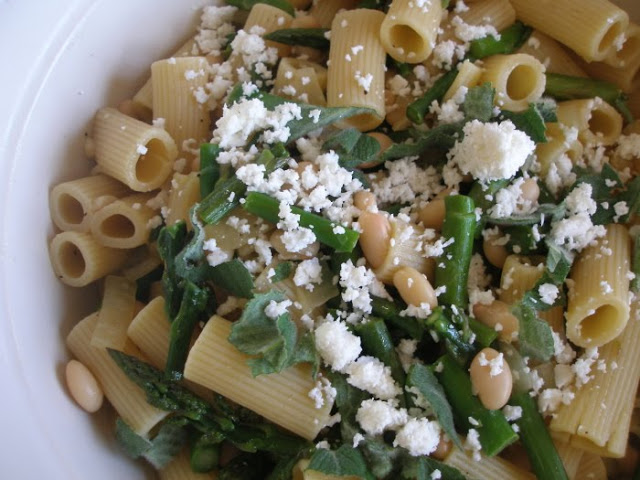
I confess, my favorite thing about Jane's cookbook... her pasta and pizza recipes. Spring is right around the corner and as soon as asparagus is in season, I'm making this dish...
Pasta with Asparagus, White Beans, & Mint (p. 43)
Meet Jane...
Jane Bryan is a Christian (Mennonite) stay at home and homeschooling mom of three and wife to "pharmer" Jamey (gardener/pharmacist). As a family, their goal is to bring glory to God by living simply in order to give while striving to eat food in it's purer forms - without pesticides, chemicals, and the necessity of miles and miles of transportation.
"The bounty of all good food available to us is overwhelming in a world where so many are hungry." ~ Jane Bryan
If you'd like to know more about Jane of Thy Hand Hath Provided, please visit her blog to find out "Why We Do What We Do" or read her interview with me on the Homestead Tour from August 2010.
Enter To Win a Cookbook!
If you would like an opportunity to win a copy of the Thy Hand Hath Provided Recipes & Preserving Cookbook, all you have to do is click on the options below. Jane is hosting 2 copies so at the end of next week, Punch Tab will randomly select 2 different winners!
UPDATE 2/25/13: Jane has graciously offered to give away a THIRD cookbook! Why not order one for yourself and if you win, give one as a gift to a fellow homesteader, a new bride, or someone struggling to cook from scratch? Spread the blessings...
Friday, February 15, 2013
Must We Have Politics Served As a Side Dish to Homesteading?
When I post something political on the HomesteadRevival Facebook page, I always receive at least one comment asking me to keep politics out of homesteading. Must we include political discussions in our endeavors to homestead?
Look... I don't want to stir up emotions or hard feelings here. I don't want to be a conspiracy theorist. Nor do I want to see evil lurking behind every tree. But freedom of choice in our country is rapidly disappearing and I never dreamed it would be food related. It's becoming harder and harder to pretend we don't have a food issue. (Perhaps I'm preaching to the choir here... please bear with me.)
Wherever there is money, there is the potential for priorities to become skewed. Now you may not THINK agricultural endeavors are big business (because seriously, none of us are getting rich at this, right?), but on a national level, Big Ag IS making serious money. We don't see it because it's only a handful of corporations that ARE Big Ag (Monsanto, Cargill, DuPont, etc.)
Besides the money issue, there are only a few things that are REALLY necessary for life, and food is at the top of the list along with water and air. If you look back over history, you’ll realize wars have been fought over food resources and for centuries, the trading of food has been considered a form of monetary exchange. Those with available food (and land, because land equals more food potential) were considered the wealthy and often had “noble” status. Read Salt: A World History by Mark Kurlansky to get an idea of how just one food commodity changed nations.
So... why do we bury our head in the sand and say that food is not political? Sure, I’d MUCH rather hang out with my goats and chickens, munch sugar snaps straight off the vine, sing kum-ba-ya, and ignore the political roar in the background. But as in most generations since Adam and Eve, our food supply is at risk and we need to be alert, attentive, and active. The only difference since the dawn of time is the players and venue have changed, but the fight is as old as the hills.
ALERT
Be aware that someone wants your food supply under their control… Big Ag. The UN. Honestly, it’s so big; it’s kind of hard to identify all the players. The point is to know that this is happening and acknowledge the fact you can’t ignore it.
ATTENTIVE
Set aside some time each week to do some research… thirty minutes, an hour, whatever you can carve out. Watch for laws and regulations that will limit your freedom to purchase or grow food of your choice. Find some good news sources that gives reliable information and read them weekly. Farm to Consumer is a good example.
ACTIVE
Reposting news and information on Facebook, Twitter, and blogs is excellent. The more people that can be educated about current food and farming restrictions, the better. But don’t stop there. Write a letter. Financially support a group that lobbies for a cause you believe in, such as raw milk sales. Take part in a rally. Join a CSA and support a small farmer. Refuse to buy Big Ag products (in as much as it is humanly possible). Grow and raise your own groceries and share the bounty when possible and tell the recipient why you do it (they're bound to ask)!
Current News You Should Be Aware Of
As of January 1, 2013, the fight against small farmers and food freedom seems to have hit a new high. Perhaps Monsanto feels energized from their recent victory in California over the defeat of food labeling laws on GMO products. Here's a few examples...
Politicol News: Farm Bill Gives Monsanto Unbelievable Powers over US Food Supply
Natural News: Big Ag group trying to ban raw milk sales in South Carolina - your help needed to stop this tyranny
A Word For Readers Who Farm for Big Ag
If you’re still reading at this point, I commend you! I realize that you’re probably very angry. Angry at me, angry at those who would seek to take away your income, and probably even angry at Big Ag who tends to make life difficult, squeezing out every bit of profit they can (which often means you and your family make the sacrifices directly, not the corporate heads). I recognize the hard work you do and your desire to provide others with food. It’s a noble calling indeed and many don’t acknowledge or appreciate what you do.
Let me throw out a few thoughts for you to ponder…
• Is the current method of conventional farming really seem sustainable? In other words, do you feel that current farming methods are realistic on an on going basis?
• Does it seem logical that every year the rules/requirements change; often dramatically?
• Are you having to work two or three jobs just to make ends meet?
• Is this how your grandparents farmed? great-grandparents? What would they say about the methods we're using today?
• Are you feeling peace about your stewardship calling (based on Genesis 1:28-30 AND Proverbs 12:10a)?
• Is this how your grandparents farmed? great-grandparents? What would they say about the methods we're using today?
• Are you feeling peace about your stewardship calling (based on Genesis 1:28-30 AND Proverbs 12:10a)?
Final Thoughts
In case you’re not sure where I stand politically, let me lay it out clearly:
• I am an ultra conservative on moral issues such as abortion, religion, etc.
• I am very conservative on constitutional issues such as gun rights, free speech, etc.
• I’m in a class not covered by liberals or conservatives when it comes to environmental issues – following Genesis, I believe we are to take dominion over the earth and subdue it, but I do not believe that means destroying massive parts of it and then ask God to fix it. We are to be good stewards of the earth without worshipping creation itself. So often it may APPEAR I’m an environmental liberal, but I'm not. Neither am I a traditional conservative in this area. (I highly recommend Noah Sander's book Born-Again Dirt for a better explanation).That said, I often find that those I’m debating on the issues of GMO labeling, raw milk, and other small farming rights are the very people I side with in other political areas. Often I have voted for these people because MORALLY they are conservative, but in terms of food and agriculture, we are at opposite ends of the spectrum. This creates strange bedfellows indeed, making the daily battle even more difficult.
I live in one of the most conservative counties in CA, where agriculture is king. While third in ag for the state, I’m sure it’s one of the top farming counties in the nation as well. It’s the “Bible Belt” of CA, but at the same time, Monsanto and it’s subsidiaries, rule. The representative that I support is in line with all my own beliefs EXCEPT when it comes to food. It's so disappointing and can be disheartening. Perhaps you are in a similar situation as well. What should we do?
Never underestimate the power of the local government. You have a much greater chance working with a local leader than you’ll ever have influencing a national one. Form a local lobby group and select a handful of members to meet with your local representatives. Be respectful, but firm. Know your stuff and have a prepared written statement of your group’s concerns.
I confess, perhaps I am not as active as I could or should be. But I'm doing more today than I was 5 years ago. Today I'm alert. I'm as attentive as time allows. And I am making small steps to be active. I have to... The future of our food is at stake.
Please note: Thank you for practicing kindness and civility. While debate can be a healthy intellectual engagement, comments not in keeping with Eph. 4:29 will be removed.
I confess, perhaps I am not as active as I could or should be. But I'm doing more today than I was 5 years ago. Today I'm alert. I'm as attentive as time allows. And I am making small steps to be active. I have to... The future of our food is at stake.
Please note: Thank you for practicing kindness and civility. While debate can be a healthy intellectual engagement, comments not in keeping with Eph. 4:29 will be removed.
Thursday, February 14, 2013
Friday, February 8, 2013
Peanut Butter Balls
I can not believe I haven't posted on this yet! Peanut Butter Balls are the BEST! Well, my daughter thinks so, anyway. But I bet your kids will, too, if mom and dad don't eat them after their bedtime first!
PBB make a great afternoon snack or they can be just right for a light lunch served with apple or banana slices and maple yogurt dip. And because you make them from scratch, you can control the ingredients and keep these as healthy or decadent as you please.
This recipe has lots of latitude for you to adjust ingredients, so just use your imagination and go for it! I'm posting the original recipe and then my modified version that I typically make, but it could change on any given day.
Original Peanut Butter Balls
1 cup peanut butter
1/2 cup honey
1/4 cup toasted wheat germ
1 cup Kashi puffed cereal
Walker Family Version of Peanut Butter Balls
1 cup organic peanut butter (no sugar variety)
1/2 cup raw honey
1 - 1 1/2 cups homemade granola
Using one of the recipes above, combine ingredients and mix well by hand. Roll into 2" balls and cover with toppings.
Toppings:
shredded coconut (raw or toasted)
granola
finely chopped nuts
finely chopped carob chips or chocolate chips
melted chocolate
* Toppings are easily chopped in a small coffee grinder.
Place on a cookie sheet that has been lined with wax paper. Chill in freezer just until hardened. Transfer to an airtight container and store in refrigerator. Monitor closely as these have a way of suddenly disappearing when your back is turned...
Ah, well... much healthier than a lot of things the kids could be eating!
What will you coat your peanut butter balls with?
PBB make a great afternoon snack or they can be just right for a light lunch served with apple or banana slices and maple yogurt dip. And because you make them from scratch, you can control the ingredients and keep these as healthy or decadent as you please.
This recipe has lots of latitude for you to adjust ingredients, so just use your imagination and go for it! I'm posting the original recipe and then my modified version that I typically make, but it could change on any given day.
Original Peanut Butter Balls
1 cup peanut butter
1/2 cup honey
1/4 cup toasted wheat germ
1 cup Kashi puffed cereal
Walker Family Version of Peanut Butter Balls
1 cup organic peanut butter (no sugar variety)
1/2 cup raw honey
1 - 1 1/2 cups homemade granola
Using one of the recipes above, combine ingredients and mix well by hand. Roll into 2" balls and cover with toppings.
Toppings:
shredded coconut (raw or toasted)
granola
finely chopped nuts
finely chopped carob chips or chocolate chips
melted chocolate
* Toppings are easily chopped in a small coffee grinder.
Place on a cookie sheet that has been lined with wax paper. Chill in freezer just until hardened. Transfer to an airtight container and store in refrigerator. Monitor closely as these have a way of suddenly disappearing when your back is turned...
Ah, well... much healthier than a lot of things the kids could be eating!
What will you coat your peanut butter balls with?
Subscribe to:
Posts (Atom)